
Part 5/11
It’s said that crackheads become crackheads because there’s nothing like the sensation of that first crack-fueled high. Many folks lose their money, their relationships, their careers, their families and everything in between due to their obsession with trying to get that particular high again.
It is not the same thing by a long shot, but I experienced something very similar early in my life with regard to rock music. Something hit me really hard to the point where I have spent the rest of my life in constant pursuit of another band, another record, another song that makes me have the same experience. This is how AC/DC gave way to more-accessible versions of aggressive music like 90s Thrash (Metallica, Slayer, Anthrax, Megadeth) and Grunge (Nirvana, Soundgarden, Pearl Jam) with random weird stuff like Primus and Green Jelly thrown in … but even that could only get me so far.
By the time I got in middle school (late 90s), I had graduated from 90s Thrash and Grunge to heavier bands like Pantera, White Zombie, early Marilyn Manson and even wacky stuff like Insane Clown Posse. High School introduced me to even more extreme versions of metal including System of a Down, Slipknot, Korn and Sepultura. Over the years, my taste in heavy music just kept getting heavier and more extreme.
This trend continued in college when I took a deep dive into Black Metal (all versions from Venom and Pentagram to Mayhem and Burzum to Cradle of Filth and Behemoth). As an adult, I’d then take a wild swing into Doom Metal (Sleep, The Obsessed and Electric Wizard) then randomly Death Metal (Cannibal Corpse, Exhumed and, of course, Death). As Katie says, I love to have my senses assaulted and in many cases I choose to do so by listening to something that’s sometimes harder, louder, faster, heavier or simply more evil than anything I’d ever heard before.
But I have continued chasing this because of that unbelievable feeling I got as a kid when I heard one particular album for the first time. As I stated in my post last week, AC/DC introduced me to music, gave me my first favorite band and acted as my first experience with rock. Of course, my family would introduce me to Hair Metal and Arena Rock bands like Aerosmith (Pump, 1989) and Bon Jovi (Slippery When Wet, 1986) but those guys were even less heavy than AC/DC. It wasn’t until, sitting in my friend Brian’s room, I heard a magical song unlike anything I’d ever heard before.
Brian was a metalhead who was several years older than me. We played video games in his room while his mom babysat me. He introduced me to KISS via a grotesque Gene Simmons poster on his bedroom door (that I was afraid of) and I’ll never forget the day he played “Wind of Change” by the Scorpions for me. But it wasn’t KISS or the Scorpions he played that started this.
It was a song with a palm-muted, chugging guitar riff intro under vocals that were epic in nature and lyrics about a person happening upon a ritual and then … YEAAHHHHHHHHHHHHHH!!! The longest, loudest, most legendary wail I’d ever heard from a voice rocketed over a repetitive five-count. When the song kicked in, all I could hear was the complexities – there were two guitars playing in unison but there was also a distinct bass line noodling behind the guitars in a way that was just as complex. I didn’t know music could sound like this. It was fast, it was intricate and it was SO HEAVY!
The band was Clive Burr, Steve Harris, Adrian Smith, Dave Murray and Bruce Dickenson of the mighty Iron Maiden and the song was “The Number of the Beast.”
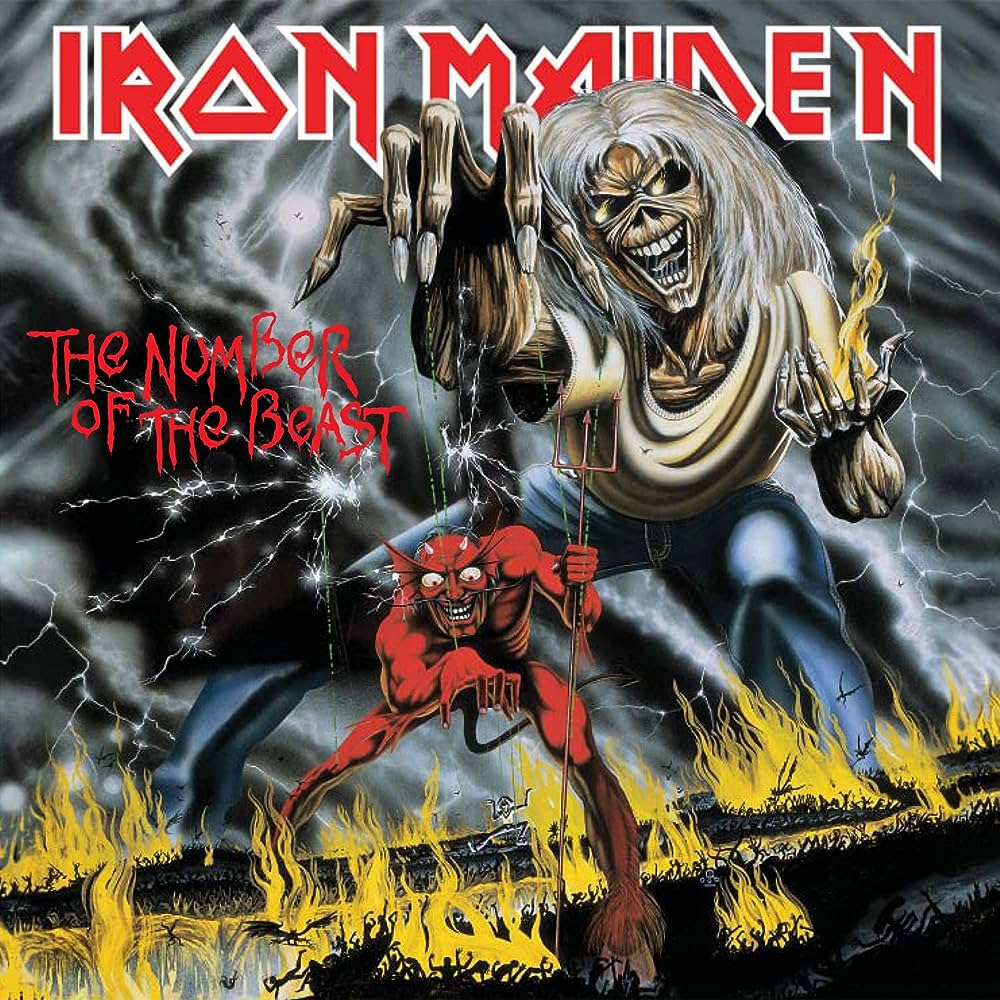
5) Iron Maiden – The Number of the Beast
Released March 22, 1982; Produced by Martin Birch
The UK was, ultimately, the birthplace of what we know as Heavy Metal. The late 60s and early 70s produced bands who would go on to be the forefathers of Metal including Black Sabbath, Led Zeppelin and Deep Purple. The early 70s brought two more things to the country: social unrest and more rock-based bands like Queen and Bad Company. Heavy music had started to wane and unemployment was on the rise. Not surprisingly, British youth began to rebel against the authority in the form of Punk Rock. The punkers brought back extreme music with a rebellious attitude but not all youth were fully on board. Some people wanted extreme music but wanted to have some fun instead of bringing the system down. Bands like Thin Lizzy, Motorhead and Judas Priest set that standard from which a new movement of heavy metal would be based – a New Wave of British Heavy Metal if you will.
Bassist Steve Harris left his band Smiler in 1975 and joined vocalist Paul Day, Guitarists Dave Sullivan and Terry Rance and drummer Ron Matthews to form a new band called Iron Maiden. Over the course of the next seven years they would get signed to EMI, experienced a number of personnel changes (including replacing Paul Day with Dennis Wilcock, who was then replaced by Paul Di’Anno) and released two powerhouse records in Iron Maiden (1980) and Killers (1981).
After the release of Killers, vocalist Di’Anno’s erratic, drug-fueled behavior caused the band to send him on his way. Upon his ousting, the band had already selected his replacement in former Samsom frontman Bruce Dickenson. Together with their new singer, the band finished their tour and even teased a few new tracks from their upcoming album – an album that would not only put the band over and leave a lasting impression on the Heavy Metal world but also an album that would greatly impact society in general across the globe.
Strong Points
The Prisoner
“The Prisoner” starts with a spoken intro from a British television show also called The Prisoner before going into a headbanging intro. Headbanging gives way to a groove that borders on Thrash. The song follows the concept of the television show that depicts a British man who resigns from his government job and finds himself kidnapped and living as a number in an Orwellian society. The dueling guitar solo in this song is the epitome of power metal with both guitarists going at it while the rumbling bass refuses to take a backseat during the melee.
22 Acacia Avenue
The second part in the four-part Iron Maiden “Charlotte the Harlot” saga, “22 Acacia Avenue” continues the story of Charlotte, a working lady of the night who does her business at the aforementioned address. In the song, the narrator points out to Charlotte the harsh realities of such a career, including fading health and physical appearance, and as a result, the loss of interest from her clientele. Fed up with her choices, the narrator ends the song by vowing to break her free from her chains. The song’s solo is sorrowful, almost like a soundtrack to Charlotte realizing the err of her ways, but for me, the highlight of the song is the melody used in the bridge – Some day when you’ve reached the age of 40, I bet you’ll regret the days when you were laying; Nobody then will want to know, you won’t have any beautiful wares to show, any more!
Run to the Hills
With the exception of this album’s title track and “The Trooper” (Piece of Mind, 1983), “Run to the Hills” is probably Maiden’s most well-known song. The song’s intro drums are reminiscent of American Indian tribal drums, which is apropos since the song is about the colonization of the Americas. Half of the song is told from the perspective of a Cree Indian witnessing the white man bringing “pain and misery” from across the sea while the other half of the song is told through the eyes of an American calvaryman “raping the women and wasting the men.” You have the song’s infamous build up, which brings to mind images of both Europeans and American Indians marching forward into battle on horseback. And nobody with a voice can resist the urge to sing along with the chorus – Run to the hills, run for your lives!
Favorite Songs
The Number of the Beast
Mercy. This song. This is the one that started it all for me. Dickenson’s epic wail that launches the song is unlike anything I’ve ever heard before or sense. The song relays the story of a man happening upon a satanic ritual in the woods, a story created in the mind of bassist Steve Harris who had dreamt the entire thing. The guitars are blazing the entire time but what impresses me the most is how prominent the bass is. Being able to hear the bassline is one of my favorite things about Iron Maiden (I suppose this happens more often in bands where the bassist is one of the prominent songwriters – ha!). The breakdown between the two guitar solos is one of my favorite parts of the whole song, putting the bass front-and-center between two shredding solos – then after the second guitar solo, what happens? A full-on BASS SOLO ARE YOU JOKING!? I don’t know if I can confidently call this song the greatest heavy metal song of all time but it’s really, really close if not.
Children of the Damned
A slow-burn of a song, this track takes you through a couple of agonizing verses before the rumbling build-up hits more than halfway through. With lyrics inspired by the Village of the Damned film series and a nod to Sabbath’s “Children of the Sea,” the song meanders and shreds its way through what can only be considered an edgy ballad – a ballad unlike anything American Hair Metal bands would attempt over the next decade.
Hallowed be Thy Name
Bruce Dickinson is everything you could ever want from a Heavy Metal frontman. His voice truly shines on this track as he sings about a death row prisoner making peace with his time on earth ending. This isn’t a thrasher or a banger or any other tired, old Metal adjective you’d like to use to describe the genre, but it’s definitely an amazing way to end an unbelievable record. Again, the bass line is prominent as the two guitars take turns playing lead, shredding away in a style that can only be accomplished by dual virtuosos. In fact, every person in this band is a virtuoso.
In addition to the entire album more-or-less acting as a partial Greatest Hits album for Maiden, one of the best features of this record is the album artwork. The illustration, done by famed artist Derek Riggs, depicts Satan being controlled as a marionette puppet by the band’s mascot Eddie. Puppet Satan is then also controlling his own marionette of a smaller version of Eddie, all in front of a stormy background and a flame-riddled ground. This artwork in addition to the title track’s lyrics inspired many American religious institutes to erroneously label Maiden a “satanic” band, spurring widespread protests and record burnings.
Regardless of whether or not you think this constituted satanism is irrelevant to the band’s success as the controversy only caused their popularity to skyrocket. Since the album’s release, the band have released live records and gone on numerous tours that utilize “The Beast” inspired phrasing and the band, itself, is often referred to simply as “The Beast.” The Number of the Beast was Maiden’s first number one record in the UK and it would land in the top 10 in Australia, Austria, the Netherlands, France, Finland, Italy and Sweden. The record would go on to sell well over two-million copies worldwide, going triple-platinum in Canada, double-platinum in the UK and platinum in Australia and the United States.
As I drive to the gym each morning blasting Cattle Decapitation, Suicide Silence, Hate or some other Death/Doom/Black/Grind Metal band, I often think of how I haven’t always liked this type of music, yet I evolved to get to that point anyway. This process is largely thanks to Brian playing The Number of the Beast for me and thereby blowing my AC/DC-soaked mind. I’ve spent the rest of my life in constant pursuit of another auditory challenge that hits me the same way.
I don’t know if that excites me about my future music taste or frightens me. I guess we’ll find out when we get there.
 Beard Hair In My Coffee 5.0
[…] of KISS yet so intrigued by the sonic assault I fell victim to at the hands of Iron Maiden. Then in the Iron Maiden post I talked about how they pushed me to seek out even more music (and all forms of art, really) that […]
LikeLike
[…] my July Review and five Albums That Influenced My Taste In Music posts (including Green Day, AC/DC, Iron Maiden, KISS and Mayhem). I also spent some time ironing out a guest post for Katie’s blog detailing the […]
LikeLike