Remember a while back when I covered my top 10 albums from high school? I called it JTF’s HS Jams Review and I covered System of a Down, Slipknot, Limp Bizkit, Soulfly, Dropkick Murphys, Sum 41, Blink 182, Less Than Jake, NOFX and Boxcar Racer? Well, I loved writing about those albums and I wanted to do it again. A couple of years ago I participated in a 10-day project on Facebook that encouraged participants to list one album that influenced your music taste per day, with no explanation. I loved the project but I hated not saying anything about the albums! Anyway, I’m doing it again now and not holding back on my explanations. And I’m doing 11. Deal with it.
I recently spoke about a time when I accidentally ate a chunk of pineapple while on a cruise when I was 15 years old and how it nearly made me gag due to my extreme distaste for pineapple. I wasn’t much of a fruit eater back then anyway but pineapple was one of the worst things I could have possibly eaten. Like I also said in that post, in a dramatic turn of events, pineapple is now probably my favorite fruit – even on pizza! Not only did my taste change but my opinion of food has changed. I’m more open minded about food and I understand food a lot deeper than I once did.
I handled wine the exact same way. I viewed wine as something enjoyed only by the sophisticated. And while I had no desire to be a yuppie or have – literally – anything else in common with these normies, snobs and the elite, I yearned to have that same sophisticated palate. It was kind of a punk rock ideal of mine to show up in my busted jeans, my Anti-Flag t-shirt, spouting anti-capitalist choruses and enjoying the same sophisticated beverage. A real slap in the face of the elitist authority. Unfortunately for me, however, I just didn’t have a taste for wine no matter how I tried. I’ve never been much of a sipper and wine is just not something that can be gulped easily. Randomly, however, it eventually just made sense. My taste changed, I became more open-minded about what I was drinking and when I understood it, I liked it.
On the outside, and even a little on the inside, it looked as though pineapple and wine were just things I disliked until I didn’t. Like a magic day happened; Like I had woken up and had developed a complex palate. But that isn’t the case and to say so would disrespect the entire process. I evolved, both in my palate and in my mentality toward new flavors and encounters.
A similar experience led me to my love and appreciation of Jazz. I admittedly didn’t have a lot of exposure to the genre growing up since nobody in my family listened to Jazz and the genre wasn’t exactly the hot thing for 90s kids in East Tennessee. I had a vague understanding of what Jazz was and could even identify the genre if I heard some of the staples. My limited exposure, however, left me with a negative opinion. I only wanted to listen to something that was heavy – THAT is how I wanted to be challenged at the time. It had to be metal or punk, otherwise it didn’t exist to me.
Fast forward to late 2009. I had accepted a job at a non-profit owned and operated by a violently conservative doctor who ran it alongside his OB/GYN private practice. Everything about that job was torturous and hysterical in its own way. I made some great friends there that I’m still connected to, but the greatest benefit I received from this job was working under Chris. He was not-quite-double my age, was married with no kids, was highly versed in music history and was just a really cool guy to hang out with. His wife was a private chef who often made goodies for Chris to bring to work for me to try. I still miss her mushroom-pesto calzones and I cherished our friendship.
Chris was plugged into the local Jazz scene, though I don’t think he was a musician himself. He knew the players, the venues, the selections, the modes, the history … all of it. When I told him I wasn’t a fan of Jazz he was incredulous. How on earth could someone be such a big fan of Ska and not like Jazz, afterall? He told me he was going to bring me some stuff to listen to — sort of a Jazz 101 class, if you will. I wasn’t fully prepared to give it a fair shake but I agreed to his test.
Over that weekend I watched a documentary on YouTube about the 1960s Jamaican Ska band the Skatalites. It was there that I learned original, traditional Ska was directly influenced by American Jazz and R&B radio broadcasts. One of the original Skatalites is also on the record saying the reason he wanted to become a musician was because of American Jazz artist Johnny Coltrane. I was intrigued and then blown away when I came to the office on Monday to find that Chris had brought me a number of Jazz selections including Miles Davis’ Kind of Blue (1959) and Round About Midnight (1957), Thelonious Monk’s Monk’s Music (1957), Charles Mingus’ The Black Saint and the Sinner Lady (1963) and both John Coltrane’s Side Steps box set and Africa/Brass.

1. John Coltrane Quartet – Africa/Brass
Released September 23, 1961; Produced by Creed Taylor
First, a little history:
Much like most other Jazz musicians of the era, Coltrane idolized saxophonist Charlie “Bird” Parker and was able to play with him in the late 40s. He learned, much like his fellow Bird followers, that Parker’s erratic behavior and drug use made him a liability, thereby encouraging other young Jazz musicians to pick up where he left off. By the mid-50s Coltrane had played with trumpeter Dizzy Gillespie, saxophonist Johnny Hodges and saxophonist Earl Bostic among others. In my opinion, however, Coltrane’s greatest blessing was getting a call from Miles Davis in 1955.
He joined Miles’ “First Great Quintet” with pianist Red Garland, bassist Paul Chambers and drummer “Philly Joe” Jones. Together they released Cookin’ (1957) and Relaxin’ (1958) before Coltrane’s heroin addiction removed him from the band. He then picked up a gig playing with Theloneous Monk at the Five Spot in NYC, which was another powerhouse collaboration. He’d then briefly return to Miles Davis (a sextet at that point) and contributed to his records Milestones (1958) and Kind of Blue (1959).
Around this time, Coltrane came into his own, releasing Blue Train (1958), John Coltrane with the Red Garland Trio (1958) and Soultrane (1958) under Prestige and Blue Note Records, then Giant Steps (1960), Coltrane Jazz (1961), My Favorite Things (1961) and Olé Coltrane (1961) on Atlantic Records.
By 1961, Coltrane had switched from playing alto saxophone to soprano saxophone, had his Atlantic contract bought out by Impulse! Records and began experimenting with using two bass players – one to stabilize, the other to improvise. His contract with Impulse! was reportedly the best contract a Jazz musician had ever received at the time and he entered the studio as the bandleader to begin what would become the Africa/Brass Sessions.
One of the first things I noticed about this record is it is only three tracks long with a total runtime of 16:28 on the A side and 17:22 on the B side (I have it on vinyl now but when Chris brought me the album it was on CD). Within the first 25 seconds you’re met with the aforementioned dueling bass parts (played by Reggie Workman and Paul Chambers) just underneath a fluttering piano part played by McCoy Tyner. Coltrane hadn’t even kicked in yet and I knew I needed to sit down to appreciate this, so I did.
Strong Points:
Blues Minor
Since Greensleeves isn’t a Coltrane original, I wanted to focus more on album closer Blues Minor. Veering away from the two-bass concept, Blues Minor brings in trombonist Britt Woodman, euphoniumist Carl Bowman and alto-saxophonist Eric Dolphy who all get their time to shine over the course of the 7:20 hard-bop song. Many people think that it pales in comparison to the single A-side track, and I have to agree, but Blues Minor is strong in its own right. Workman’s running bass and Tyner’s piano playing come together to form the quintessential Jazz sound while Coltrane’s playing (often considered unimaginative by many reviews) dances around freely. It’s a beautiful track on an equally beautiful record.
Favorite Songs
Africa
The lone A-side track runs over 16 minutes long and features dueling basses, two trumpets, multiple french horns, tuba, baritone sax, piano, drums, piccolo, euphonium and, of course, Coltrane’s saxophone. The constant rumbling of the grounded bassline gives you a sense of stabilization while the other instruments take turns fluttering in and out, sometimes in harmony, other times playing as each others’ antagonist. The flow and rhythm of the track takes you on a ride that gives you an opportunity to rest every so often between bouts of free-flowing chaos. The sounds send your mind reeling almost to the point of no return before coming back to the calm sounds of bass, piano and drums, then back again. One review I read accurately states this song has absolutely nothing going on while simultaneously has everything going on.
All I have to say is this is the first song I ever listened to while intentionally trying to appreciate Jazz and it immediately made me a fan of the genre. I would go on to become a fan of the great Miles Davis (who does my favorite Jazz record of all time: A Tribute to Jack Johnson), Duke Ellington, Charles Mingus, Thelonious Monk, Herbie Hancock, Dizzy Gillespie, Ornette Coleman and the amazing Sun Ra just to name a few.
Getting into Jazz in the way that I did allowed me to experience music in a new, challenging way. It can be structured and even scientific but it can also be emotional and free-flowing. Instrumentals can say so much without using words. I may have once thought Jazz was the music of the stiff and stuffy – and I supposed some of it is – but so much Jazz is creative, left-of-center and challenging for someone like me who is always looking to have their musical horizons broadened. I wouldn’t have realized any of this without Africa/Brass.
Africa/Brass is hardly considered one of Coltrane’s stronger albums – in fact, it was poorly received at the time of its release – but I rate it highly based on how it made me feel and how it changed my attitude toward Jazz. He would go on to release 17 more albums (as a bandleader) for Impulse! – including his magnum opus A Love Supreme in 1965 – before succumbing to liver cancer at the age of 40. Many think the seeds of his death were sown during his heavy drug-use period and they’re probably right, but I love that his addictions are not his legacy.
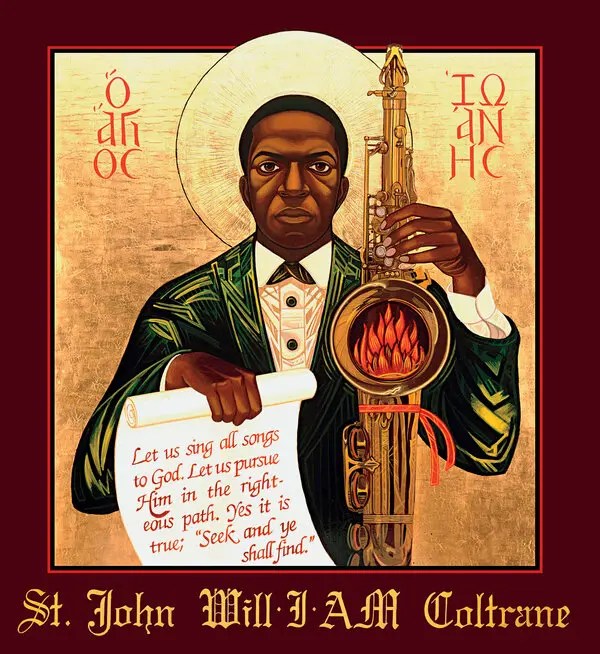
In fact, while doing some research on this post, I learned that a Charlie Parker cult in San Francisco called the Yardbird Temple equated Coltrane as their Jesus figure – as God in the flesh. This hard-bopping congregation later became affiliated with the African Orthodox Church who now recognizes Coltrane as a saint, utilizing his music in service, reading his lyrics as prayers and believing that Yahweh lives within the sounds played by the late Jazz musician.
After hearing Africa/Brass, I can’t help but think there’s some truth in that.
 Beard Hair In My Coffee 5.0