
Part 4/11
There’s a neuropsychological disorder known as confabulation where a person’s recollections are either anamorphic in nature or just downright false. This isn’t to say the memory holder is lying, per se, as lying would require the person to know the truth then intentionally stray from it. Confabulation is a condition where the memories a person possesses are either fraudulent or, at best, distorted. The reality is these people truly believe these fictitious memories come from a real experience even though they, in fact, did not.
Most of the memories I have of my biological father are scattered and even many of those are likely a result of confabulation. I remember his voice but remember very few things he said to me over the years – “Sometimes you embarrass the shit out of me,” and “daddy’s broke,” and “why did you give Tammy the finger?” (something I was accused of in the sixth grade that never happened). I vaguely remember his Suzuki motorcycle, the layout of his house, the color of my bedroom’s walls and the lazy Susan in the kitchen’s corner cabinet. Many of my childhood memories involve these places and my dad but those memories are so far gone (some forcibly removed) that I think a lot of what I remember is made up to fill in the gaps.
One thing I definitely remember, though, was my dad’s maroon GMC truck. He’d had a bigger truck before this that was black and had what seemed like a million fog lights on it but he’d traded for the GMC pretty early in my life. One of the most vivid memories I have of being with my dad in the GMC truck was going to see the Christmas lights in Pigeon Forge and Gatlinburg in 1992. It was just the two of us and I remember seeing many of the lights on our trip. I also remember coming home late, popping the cassette tape out of the console and feeling how warm it was.
AC/DC’s LIVE album had come out that year and we were proud owners. Both sides of the tape had seven tracks and had a total run time of a little over an hour. It takes about two hours to drive to Pigeon Forge from Kingsport and we probably spent two-three hours looking at lights before driving back. That’s six or seven hours in the truck and we listened to AC/DC LIVE the entire time. When the A-side would finish, the cassette deck could “flip” the cassette on its own and immediately play the B-side, then do the same back to the A-side. We probably listened to this record in its entirety at least six times on that trip. Nothing else.
We were definitely an AC/DC household and for many years of my life I didn’t know any other band existed. I thought AC/DC were the only band in the world and every time I heard music on a cassette tape, on the radio or on TV, I just assumed it was them. Before we tirelessly listened to LIVE, we did the same with the band’s 1990 record The Razor’s Edge but before that, the only tape we ever listened to was one of classic rock’s most beloved albums, Back in Black.
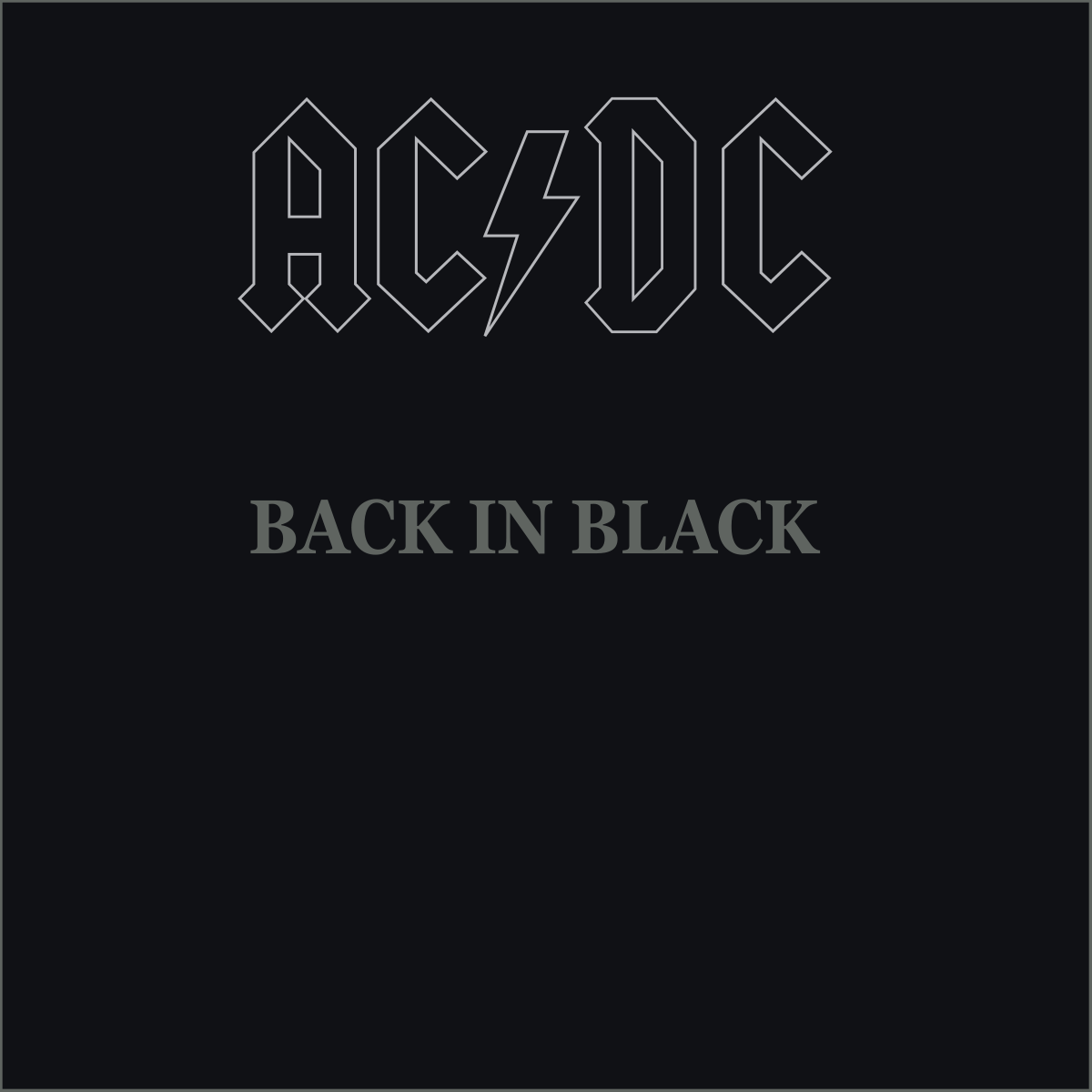
4) AC/DC – Back in Black
Released July 25, 1980; Produced by Robert John “Mutt” Lange
I may be mistaken but I think I have my uncle Dean to thank for this as I’m pretty sure it was his cassette that we kept buried in my dad’s cassette player in the old GMC. The album not only introduced me to music and rock’n’roll but it also served as my introduction to cassette tape technology. I’d later find my mom’s cassette collection, which would introduce me to the likes of Poison, Madonna, Led Zeppelin and Prince … and my aunt had a handful of cassettes in her truck that included Aerosmith, Alice Cooper, Motley Crue and Bon Jovi … but for a long time, that pearly white cassette tape in the plastic case with the nearly solid black cover art was the only cassette tape I was aware of for a long time.
By the time Back in Black had been released, the band had already gone through two singers – Original vocalist Dave Evans joined the band during its formation in 1973 and was ousted after about a year. Evans’ replacement, Bon Scott, passed away in early 1980 just as work for Back in Black had started, having fronted the band for seven years. Their next lead vocalist, Brian Johnson, had some big shoes to fill. Not only was he there to carry on the legacy the great Bon Scott helped create, he was also tasked with fronting an album released after sluggers like High Voltage (1976), Dirty Deeds Done Dirt Cheap (1976), Let There Be Rock (1977), Powerage (1978) and the infamous Highway to Hell (1979).
The recording process for Back in Black was reportedly less than stellar. Despite taking advantage of recording time available at Compass Point Studios in Nassau, laying down the tracks for Johnson’s debut with the band was far from paradise. There are stories of the shoddy arrangements inside and the rowdy Haitians who stood by ready to burgle the studio in the event the doors were left unlocked at night (there were six-foot fishing spears kept by the door to help keep the would-be thieves at bay!). To complicate matters even more, electricity at the studio was continuously interrupted by a series of tropical storms and much of the band’s equipment was held up in customs while another chunk was taking its sweet-ass time shipping over from the United Kingdom.
Despite the hardships of recording, the guys cranked out 10 top-quality rock songs over the course of about seven weeks. The record was then taken to New York City to be mixed at the famous Electric Lady Studios, originally opened by Jimi Hendrix. The hard part was done, now it was just up to the public to weigh in on what they thought of their favorite band from Down Under and their new British frontman.
Strong Points
Back in Black
The album’s title track, “Back in Black” is a bad-ass tribute to the band’s late singer, Bon Scott. It was the second single from the album but has since gone on to be one of the band’s most well-known tunes. As a kid, I remember my parents emphasizing the famous countoff that includes a palm-muted guitar and closed high-hat cymbal, then fully rocking out when the song’s iconic intro riff is played. What follows is classic AC/DC – a simple 4/4 time signature, simple chords and bluesy guitar licks. And while this song is the first track on the B-Side of the record, for years I always thought it was the opening track for the album since it’s what we listened to the most. I would even go so far as to say this was probably the first actual song I ever heard and identified as music. Finally, I’ve always loved the last few lines from the first verse: “I’ve been lookin’ at the sky ‘cause it’s gettin’ me high; forget the hearse ‘cause I never die; I got nine lives, cat’s eyes; Abusin’ every one of them and running wild.” From what I understand about Bon Scott, there isn’t a much better way of describing the life the man led. A tribute that’s truly apropos.
Have a Drink on Me
When it comes to AC/DC, you can guarantee their songs are either metaphors for sex or are simply to be taken at face value, no metaphor required. This is certainly the case with “Have a Drink on Me.” “Dizzy, drunk and fightin’ on tequila white lightin’; My glass is gettin’ shorter on whiskey, ice and water.” Pretty straight-forward tune about getting blitzed with the boys. I’m not a huge drinker and don’t normally love songs that glorify that type of behavior but it’s that intro lick that does it for me. Three simple notes hammered on then drawn out, almost like a false start. The tone is killer in this song, with the guitar pounding away its bluesy goodness over that good ol’ 4/4 again. The icing on the cake here is the fun gang vocal on the song’s outro. You’re a part of the gang whether you want to be or not.
You Shook Me All Night Long
The first single released from Back in Black, “You Shook Me All Night Long” was the world’s introduction to this new version of AC/DC. And what a way to introduce yourself! Like I said before, AC/DC sing about nothing if it isn’t a straight-forward message or sexual innuendo and this song is chock full of the latter. One can only imagine the Bahamian babes surrounding the guys with their clean motors, “sightless eyes,” and “American thighs.” And to keep it nice and simple, the band keeps the 4/4 again and overlays it with a good old-fashioned G-C-D chord progression common in blues.
Favorite Songs
Hells Bells
I’ve written before about how this song was my introduction to horror. The ominous bell that kicks off the track is so foreboding it would drive little-kid me to want to fast forward through it. Even the intro guitar riff is scary! Another nod to late singer Bon Scott, this song is filled with references to being a hellraiser complete with metaphorical lyrics of destruction inspired by a tropical storm that was rolling into the Bahamas as the guys were working on the album. When I was a kid, I didn’t understand what Satan was but I knew I didn’t want it to get me based solely on how threatening the name seemed in Johnson’s gravel-voiced wails. While doing some research for this post, I learned that the guys didn’t immediately have access to the style of bell they wanted (and that would eventually accompany the song on the recording) so they attempted to record church bells in Nassau. Reportedly the recordings were scrapped, however, because each toll of the Bahamian bells was accompanied by the chirping of some friendly island birds – not birds of the hell variety, unfortunately.
Shoot to Thrill
Up until I was researching information for this particular post, I assumed “Shoot to Thrill” was another sexual metaphor. I then learned that it’s a song about a British pusher selling narcotics to lonely, horny and bored housewives who would then hit the clubs in search of an extramarital affair. WILD! I told Katie it’s weird for me to think of people acting skeezy in the UK, even though I know they’re just as trashy as us. Having that British accent just makes the sleaze a little cooler, I guess. Aside from the melody of this song’s bridge, the coolest part of this entire ditty is the breakdown after the post-solo chorus. The band revealed that it’s based on a shootout scene from The Good, The Bad and the Ugly where the climactic, fiery finale is preceded by a painfully long, anticipatory build-up.
Rock and Roll Ain’t Noise Pollution
The Marquee Club is a rock venue that opened in London in 1958. Initially a jazz venue, the Marquee was the location of the Rolling Stones’ first live performance (1962) and hosted a variety of raucous acts over the next two decades – including, but not limited to, The Yardbirds, Led Zeppelin, the Who, King Crimson, Yes, Jethro Tull, the Jimi Hendrix Experience, Pink Floyd, Fleetwood Mac, Queen and David Bowie. In the late 70s punk acts from the Damned and Generation X to the Buzzcocks and the Sex Pistols were regulars there as well. And with those bands comes the inevitable noise complaints from folks trying to live, work and do business in the otherwise polite Soho neighborhood. “Rock and Roll Ain’t Noise Pollution” is AC/DC’s direct response to these complaints and is a quintessential blues-rock banger. Legend has it the band only wanted to do nine songs for Back in Black but were pressured into making it an even 10, so they wrote this song in 15 minutes. And while it’s not surprising that a song so simple – a standard blues song about how bitchin’ rock and roll is can’t be too hard to concoct – it’s that simplicity that has made AC/DC so timeless. And what better band to come to the defense of rock and roll than one that ruffled feathers for playing so loudly in Auckland in 2015 that their show could be heard four miles away?
Brian Johnson had a tall order to fill – sing your ass off for a well-established band, win die-hard fans over and step out of Bon Scott’s shadow while simultaneously paying respect to everything he’d done for the fans, for the band and for the world. The album went straight to number one in Australia, Canada, France and the UK. It has been certified 25x Platinum in the United States and multi-platinum (2x-12x) in Argentina, Australia, Denmark, France, Germany, Italy, Switzerland and the United Kingdom. The album has sold over 50-million copies worldwide and is one of best-selling albums of all time, second only to Michael Jackson’s Thriller. I’d say he did okay.
Back in Black is not my favorite AC/DC album (I’d have to go with either The Razor’s Edge (1990) or Ballbreaker (1995)) but it was Back in Black that introduced me to rock and roll and it has been in somewhat regular rotation for all 38 years of my life. I am, and will forever be, in debt to the mighty AC/DC because of it.
 Beard Hair In My Coffee 5.0
[…] posted my July Review and five Albums That Influenced My Taste In Music posts (including Green Day, AC/DC, Iron Maiden, KISS and Mayhem). I also spent some time ironing out a guest post for Katie’s blog […]
LikeLike
[…] weeks ago when I posted about AC/DC’s “Back in Black,” I talked about my dad’s GMC truck and how we only listened to The Thunder from Down Under on […]
LikeLike