Part 7/11
It’s kind of funny to me how I spoke about being so afraid of KISS yet so intrigued by the sonic assault I fell victim to at the hands of Iron Maiden. Then in the Iron Maiden post I talked about how they pushed me to seek out even more music (and all forms of art, really) that challenged me – made me feel something. Artists take the time to translate their vision into their medium of choice and I think it’s disrespectful and lazy to always try to avoid art that rattles you. To me, a cookie cutter has no heart so if you’re into all the radio’s pop hits that all sound the same because they’re easy to digest, aren’t offensive and makes you fit in with the crowd, then you’re showing blatant disrespect to artists who put their hearts on their sleeves and spend their time innovating.
Black Metal was a genre that I missed for a long time because either I just hadn’t evolved to appreciate it yet or simply hadn’t been exposed to it during my elementary, middle and high school years. As I learned more about it, though, it didn’t surprise me that I started to take an interest. The genre itself was an evolution of 1980s Thrash and Death Metal – two sub-genres I was (and am) a huge fan of. England’s Venom formed in 1978 and played an instrumental role in building what would later be referred to as the “First Wave” of Black Metal – the genre’s name itself comes from the Venom song of the same name. Venom was joined by Swiss metal band Hellhammer in 1982 and Swedish metal band Bathory in 1983 to form the original movement characterized by lo-fi sounds and music inspired by Black Sabbath, Coven and Motorhead.
The Second Wave of Black Metal, arguably the most well-known, has its roots in late-80s Norway when guitarist Euronymous, bassist Necrobutcher and drummer Manheim came together under the Venom-inspired name Mayhem. The guys would leave their mark on the scene a number of times – for starters, the band’s third frontman Pelle Yngve Ohlin (aka “Dead”) gave Black Metal its image. He would bury his stage clothes then dig them up the night of the concert, often cut himself with hunting knives and broken glass on stage, was known to breathe in the scent of a dead animal he’d brought in a paper bag before performing and, most notably, introduced the concept of corpse paint that is now synonymous with the genre.
Dead’s most impactful moment with the genre, however, was when he committed suicide in the band’s cabin while they were writing their first record. His suicide note apologized for making a mess and for firing a gun indoors, and his freshly-exploded corpse was forever captured in a photograph taken by Euronoymous upon finding the body. The infamous photo would later be released as the album cover on a collection of bootlegs in 1995 called The Dawn of the Black Hearts.
The band had lost their singer and the grief of the situation led Necrobutcher to leave the band just before they were set to record their debut album De Mysteriis Dom Sathanas. In an attempt to pick up the pieces and get something recorded, the band hired two session musicians including bassist Varg Vikernes, which would prove detrimental to a band who had seemingly already had enough at that point.
Vikernes was the prime suspect in the burning of a number of historic churches in Norway, though he was mistakenly found not guilty in all cases. He had also planned to blow up a cathedral in Norway in 1993 with bandmate Euronymous but those plans waned after the former’s murder of the latter. Vikernes is said to have entered Euronymous’ apartment where he proceeded to stab him 23 times. Euronymous was now dead and Varg was sentenced to the maximum in Norway of 21 years, leaving the remaining members of Mayhem to throw their hands up and call it quits. That fateful debut album wouldn’t get released until the next year, the famous cathedral gracing its cover. At that point, Mayhem wasn’t even a band anymore.
The self-mutilation, the church burnings and the brutal murder of a bandmate are all well documented in the book Lords of Chaos: The Bloody Rise of the Satanic Metal Underground by Michael Moynihan and Didrik Soderlind (1998) as well as the documentary Until the Light Takes Us (directed by Aaron Aites and Audrey Ewell) (2008). I had gotten my hands on the book around the time the teaser trailer of the film was released – that was enough to pique my interest in this incredibly brutal genre of music, so my lessons began.
With all the drama and controversy surrounding a variety of members that all seemed to play — or had at one time played — for Mayhem, I figured that was the band I needed to start with. So my proper introduction to Black Metal came in the form of the band’s first commercial release, a six-song EP called Deathcrush.
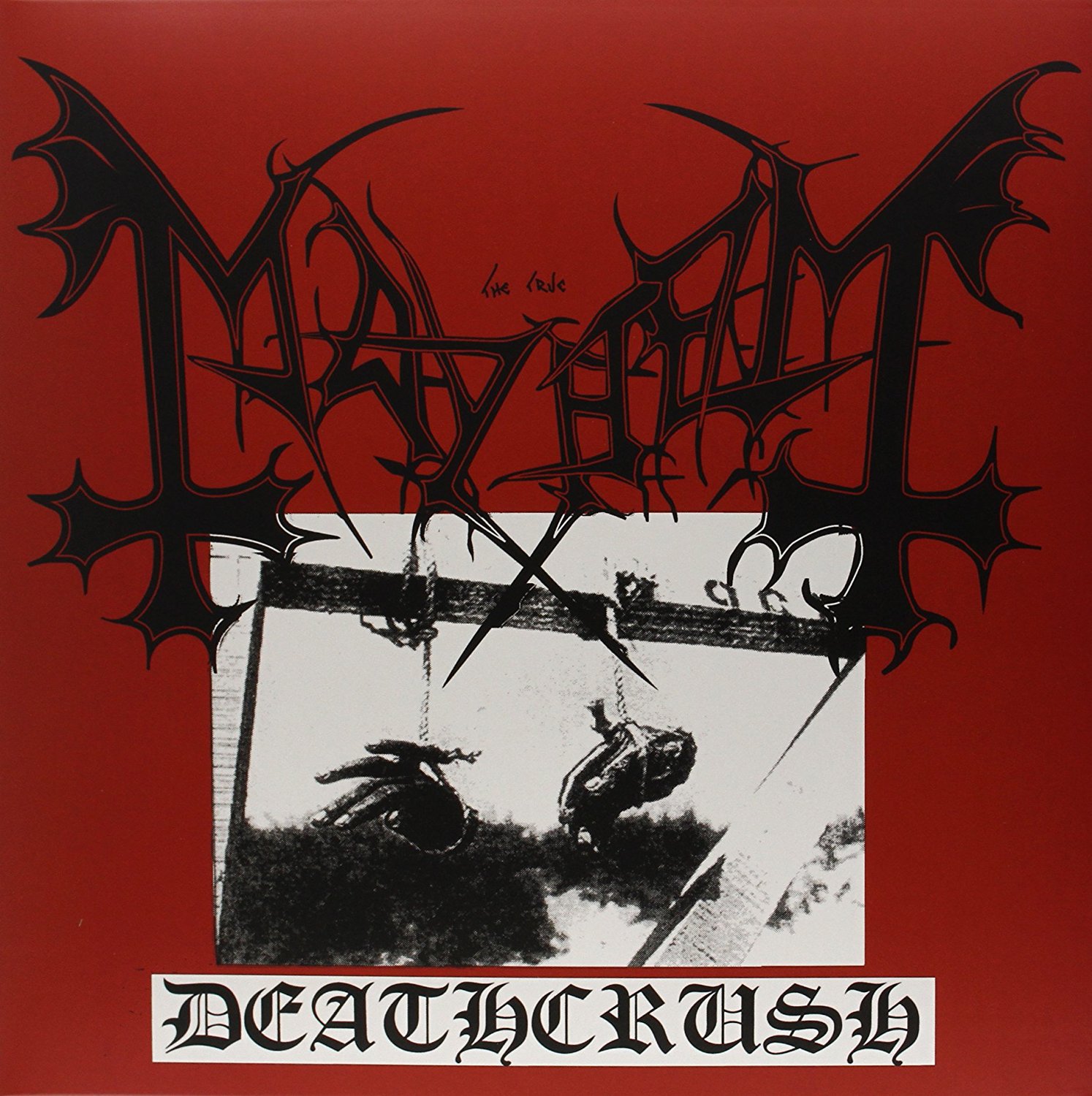
7) Mayhem – Deathcrush
Released August 16, 1987; Produced by Erik Avnskog
Deathcrush happened long before any of the aforementioned fiascos. As I stated, Mayhem started with a guitarist, bassist and drummer in 1984. Together they played covers of Sabbath, Motorhead and Venom (of course), then in 1985 they brought in vocalist Messiah who quit after just one gig and was replaced by Maniac. Real name Sven Erik Kristiansen, Maniac was in Mayhem from 1986-1987 and was the band’s vocalist at the time Deathcrush was recorded.
The album consists of eight tracks that include an instrumental intro written and performed by experimental German musician Conrad Schnitzler, a cover of Venom’s “Witching Hour” and a brutal hidden track just after the album’s closer. With the exception of “Witching Hour” and Schnitzler’s “Silvester Anfang,” all four members of Mayhem are credited as songwriters on each track (though Dead claims Necrobutcher wrote all the lyrics). The sound quality is lo-fi but pleasingly so, the musicianship is surprisingly complex, the lyrics are neither particularly poetic nor something you’d want your mom to read and the entire record was recorded live with the vocals added on a separate track.
The record was released by Posercorpse Music, a record label founded by Euronymous in 1987 designed to focus entirely on Black Metal. The label would go on to be called Deathlike Silence Productions and was headquartered at Helvete, a record shop also owned and operated by Euronymous until he was murdered.
Strong Points
Chainsaw Gutsfuck
At this point in the band’s history, their lyrics were primarily aping those of the Thrash and Death Metal bands that came before them, and lyrically speaking, “Chainsaw Gutsfuck” is nothing if not a Death Metal song. Something about Death Metal that many people don’t understand is that the lyrics are intentionally gorey – almost comic-book in how over-the-top and grotesque they are. In no way are the bands promoting murdering someone with a chainsaw or doing the naughty with their guts, however the listener is supposed to react to it as if they were. I love the heavy bass intro to this song and the multiple musical “movements” present. For real, though – don’t read the lyrics.
Pure Fucking Armageddon
“Pure Fucking Armageddon” is one of Mayhem’s most well-known songs and is often how they close out their sets to this day. Not an officially listed song, the track is hidden after album closer “(Weird) Manheim” and is originally from a demo of the same name that was released a year prior. Lyrically, the song is a word/phrase bank that one can use to fill in a Black Metal mad-lib but the simplistic lyrics paired with the rapid-fire drums and heavy guitars leaves you grinding your teeth while flying 1,000 miles per hour (or kilometers if you’re Norwegian like these lads). At that speed, one needn’t wax philosophical anyway.
Favorite Songs
Deathcrush
That guitar intro is just delicious. Truthfully, the musical elements of the song perfectly illustrate the song’s lyrics about crushing someone’s skull with an ax – a very Norwegian Viking thing to do. I think my favorite part of this song is how comically brutal the second verse is: “I’ll send you to your maker; I’ll send you to your death; Death, nicely crucified; Death, heads on stakes; The barbecue has just begun!” And normally I would make fun of a metal band who just names their songs (or themselves) after compound words they’ve made up from two unrelated-yet-violent/spooky words but I give them a pass on every instance of that on this record … and there are many.
Necrolust
This is my favorite song on the album. By this point you can probably see that Mayhem weren’t really known for using metaphors so you can probably guess what this song is about. Another violently heavy intro leads into a Death-Metal-style chugfest that later gets a little flair. If the entire track was composed of only the first minute of the song, it would still be my favorite tune on the album. Alas, the first minute makes up only the first third of the song that quickly turns Thrash. Again, maybe don’t read the lyrics … ever … but bang your head as hard as you can to this Black Metal classic.
The original release of Deathcrush in 1987 was limited to 1,000 copies that reportedly sold out quickly. Despite its cult success and its current standing as a Black Metal piece of gold, one of the hallmarks of the genre is that it is so anti-mainstream that hitting the charts would immediately be considered the act of a poser, resulting in expulsion from the scene. With that said, Deathcrush unsurprisingly went under the radar the world-over on the charts, though Kerrang! Magazine did put it in their top 20 and “Chainsaw Gutsfuck” was awarded “Most Gruesome Lyrics Ever” by Blender Magazine in 2006.
Mayhem would rock the world with their many unfortunate (and often violent) incidents, but they also launched the careers of Merciless, Burzum, Enslaved and inspired future Black Metal superstars from Cradle of Filth to Behemoth. What they did for me, however, is create actual risk in music. Unlike Death Metal with its fabricated fictional violence, Mayhem – and by extension, Norwegian Black Metal – created a genre of music that was legitimately dangerous. And while I do not, and never will, condone the burning of churches or murder, knowing that Norwegian Black Metal was that dangerous is enough to keep me a little on edge while listening.
And as weird as it sounds, I love that part.
 Beard Hair In My Coffee 5.0
[…] Albums That Influenced My Taste In Music posts (including Green Day, AC/DC, Iron Maiden, KISS and Mayhem). I also spent some time ironing out a guest post for Katie’s blog detailing the fab design […]
LikeLike